Starting, Charging & Batteries
Areas Served:
Rexburg, ID // Blackfoot, ID // Driggs, ID // and surrounding areas

Benefits of Starting, Charging & Batteries
Slow cranking engines and dim headlights can sometimes point to a problem with your vehicle’s starting and charging system. Because the battery is required for the electrical charge needed to start the rest of the electrical system, a weak or dead battery can also prevent your car from starting. If a jump start refuses to revive your battery and the starting system, our staff may need to take a closer look at the other components of the starting and charging system to determine whether or not you need a starter replacement or an alternator replacement. All components within your vehicle’s starting and charging system are necessary to ensure proper working order, and one bad link between them can render the entire electrical process useless. If you experience problems with starting your vehicle or maintaining its power even after trying a jump start, then allow our service staff to perform a starting and charging system check on your vehicle today.
Clair & Dee's Point S Tire & Auto proudly serves the Starting, Charging & Batteries needs of customers in Rexburg, ID, Blackfoot, ID, Driggs, ID, and surrounding areas.
Alternator Replacement
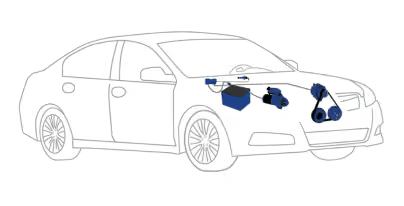
An alternator is part of a vehicle’s charging system, and is an essential component in keeping a vehicle operable. The alternator works with the battery and voltage regulator to keep electrical components running. Usually located near the front of a vehicle’s engine, an alternator can be identified by its aluminum body, vents, and an internal or external cooling fan. Depending on the vehicle, the alternator pulley is driven by either a serpentine belt or v-belt. This mechanical energy is then converted into electrical energy as internal parts operate to create a magnetic field used to produce the alternating current output. The alternator can reach high temperatures fast, so an operative cooling fan is important. Although the battery can keep the vehicle running for a little while, it will not be able to keep it running for an extended period of time if the alternator malfunctions. In fact, the alternator serves as the charger for the battery as well. Because a bad alternator will eventually render the vehicle inoperable, it is imperative that a driver have this component repaired or replaced as soon as possible.
Approx Time:
120 Minutes
Starter Replacement
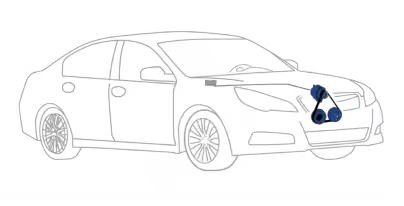
The starter is a motor that, when supplied with electricity from a vehicle’s battery, will engage the flywheel ring gear and crank the engine. When a driver turns the key to start the engine, the battery sends a small supply of electricity to the starter solenoid. In turn, the solenoid powers the motor which sends a gear to mesh with the ring gear on a vehicle’s flywheel. Depending on the vehicle, the starter may be a direct drive (DD), planetary gear (PLGR), permanent magnet gear reduction (PMGR), permanent magnet direct drive (PMDD), or offset gear reduction (OSGR). In a DD starter, components are attached in a line and run off the armature. A PLGR starter has a shaft that the armature uses and is good at increasing torque. A PMGR starter is similar to a PLGR starter except the PMGR starter uses permanent magnets instead of field coils. Similarly, PMDD starters are akin to DD starters except PMDDs use permanent magnets instead of field coils. Finally, OSGR starters do not run directly off the armature. No matter the type, each starter ultimately plays an essential role in powering a vehicle.
Approx Time:
60 Minutes
Starting & Charging System Check
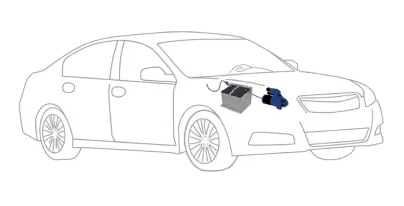
The starting and charging system is responsible for getting an engine to run and for keeping different components charged. The starting system involves a number of parts, including the ignition switch, starter, and flywheel. Using energy from the battery, the starter uses a gear to interact with the engine. Without a starter, an engine would be inoperable. The charging system, which includes the battery, alternator, and voltage regulator, play an equally important role. The battery is needed to send electricity to the starter. The alternator powers all the electrical components by generating electrical currents, and the voltage regulator ensures that the output of the alternator does not over- or under-charge the components dependent on the electrical current. Together, the starting and charging systems interact with one-another to keep a vehicle operating for its driver.
Approx Time:
15 Minutes